

Something kept asking for my attention. I think I ignored it.
A quarterly audit of attention, identity, and the things we stop noticing.

Something shifts at the end of a quarter. The noise settles just enough that you can hear yourself think — and what you find there isn’t always comfortable. This quarter, without planning it, everything I collected turned out to be about the same thing: what are you actually paying attention to and are you one of those things?
A book about who gets seen. Questions about whether I see myself clearly. A video about where attention goes when you stop guarding it. And a painting built entirely around an eye. I didn’t notice the pattern until I sat down to write this. Maybe that’s the point.
I’m not sure all of this is easy to read. Some of it wasn’t easy to write. But the things worth holding onto rarely are. Make a cup of something warm. Stay a while.
A Book That Stayed With Me
Why Have There Been No Great Women Artists?
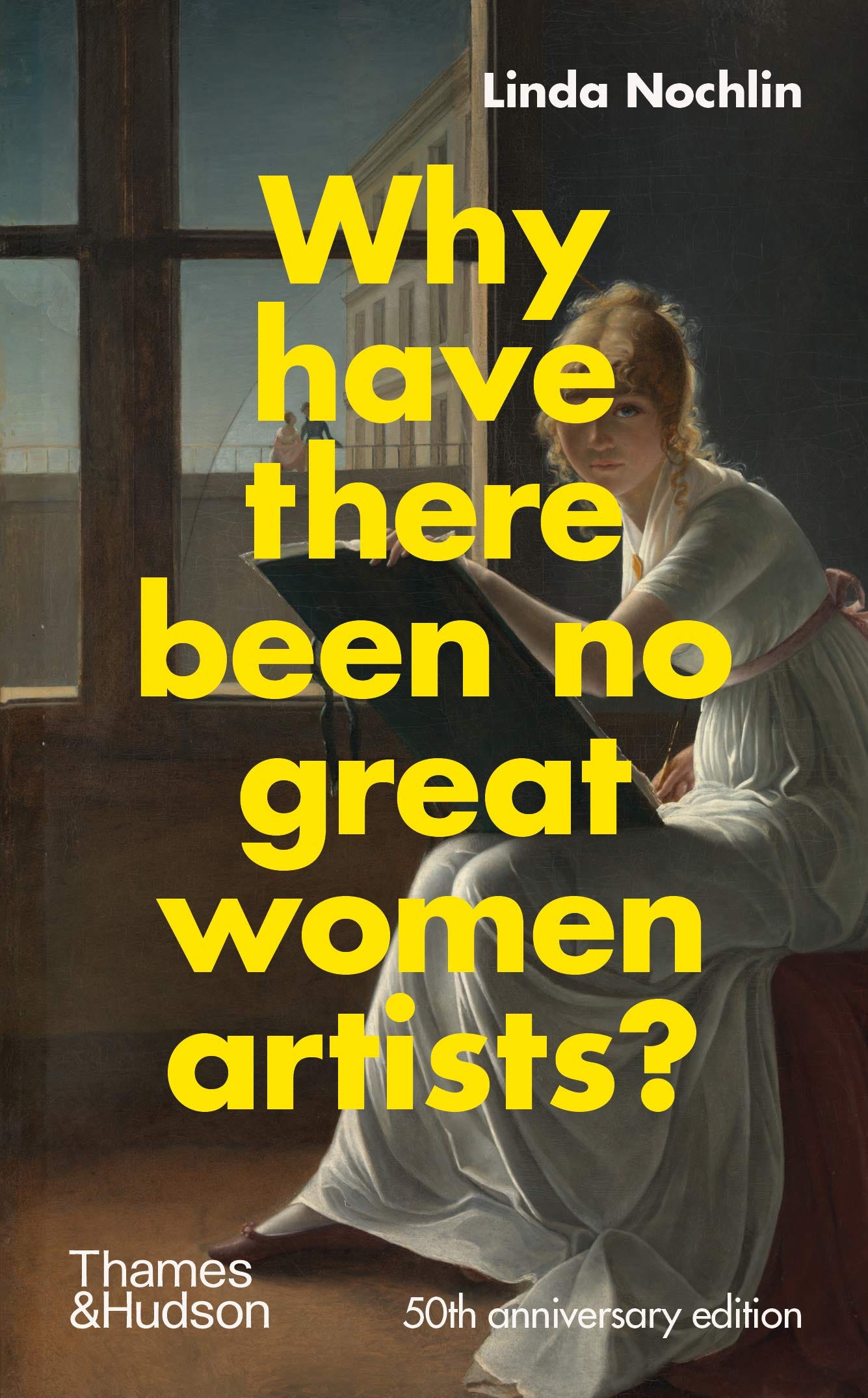
I put this book down and sat quietly for a long time. Not because it was sad, though it is, in places — but because it named something I had been carrying without knowing what to call it. That particular ache of wondering whether you’re not good enough, or whether the room was just never built for you.
What starts as an art history question quickly becomes something much bigger, a quiet dismantling of how we understand talent, ambition, and who gets to be called a genius. The argument isn’t “women were just as good.” It’s sharper than that. It asks: what were the actual conditions under which greatness was possible and who was allowed inside those rooms? The answer turns out to be deeply political. And once you see it, you can’t unsee it, not in art history, not in the world, not in the way you’ve been measuring yourself.
If you’re a woman navigating any creative field, this book will probably feel like a light being switched on in a room you didn’t know was dark. I wrote a full post about it. Go read it if you want the longer version of why I think this belongs in everyone’s hands.
Things I’m Thinking About Lately
No conclusions here. Just questions I keep returning to in the shower, mid-conversation, at 2am when I should be asleep. I’m sharing them not because I’ve figured anything out, but because I have a feeling I’m not the only one sitting with them.
Do I like me outside of the noise? Outside of the roles I play — do I have a self that exists without any structure at all?
I’ve been thinking about this a lot: how much of who I think I am is actually just... function. I am the person who creates things. Who shows up. Who holds it together. Who has opinions about art and books and the world. But strip all of that away strip the productivity, the output, the way I’m useful to other people and who’s left?
Do I even know her?
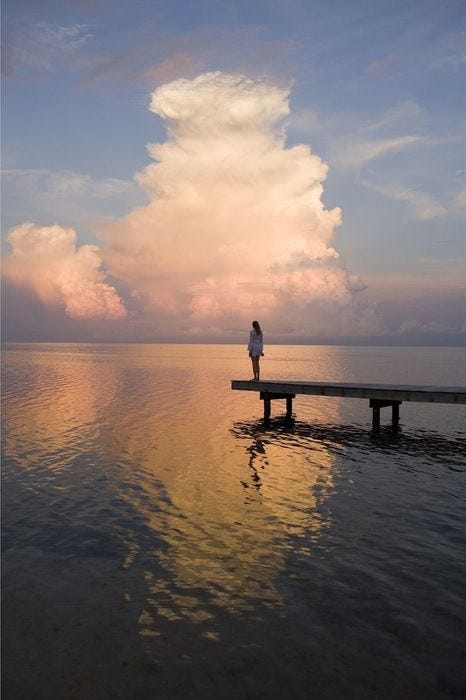
The scary version of this question is: what if I’ve been so busy performing a self that I forgot to actually have one. And the scarier version is that I’m not sure I’d know the difference.
When was the last time you did something with no audience not even yourself as an audience? No narrative forming in the background, no part of you watching and filing it away? That’s what I mean by “outside the noise.” It’s rare. Maybe I should go find her more often.
What is my relationship with anger and why does it feel like a question I was never supposed to ask?
I’ve been noticing how much I’ve been taught not explicitly, just through years of small signals — to manage my anger. Soften it. Redirect it. Make it more palatable. And I’m realising that’s not a personal thing. That’s political.
Who gets to be angry without it being used against them?
Whose anger is called passion versus whose is called difficult?
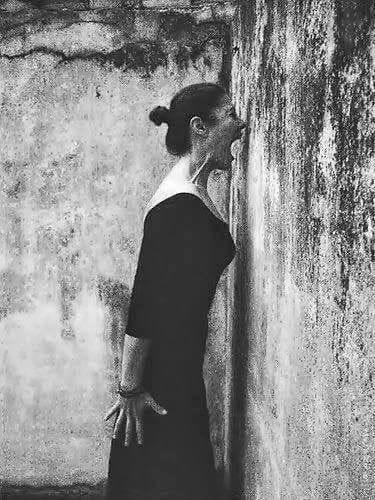
The thing I’m sitting with is this: I don’t think I fully know what my anger is actually about, because I got so good at quietly dissolving it before it became inconvenient. And now I’m wondering what information I lost in the process. Because anger, when it’s honest, is usually pointing at something true. Something worth paying attention to.
Self-trust and self-love are not the same thing. And gratitude and self-worth aren’t either.
I used to think if I was grateful enough, that meant I was okay. Like gratitude was proof that I liked my life and if I liked my life, that must mean I liked myself. But lately I’ve been picking that apart. You can be genuinely grateful for what you have and still, underneath all of it, not really like the person living it.
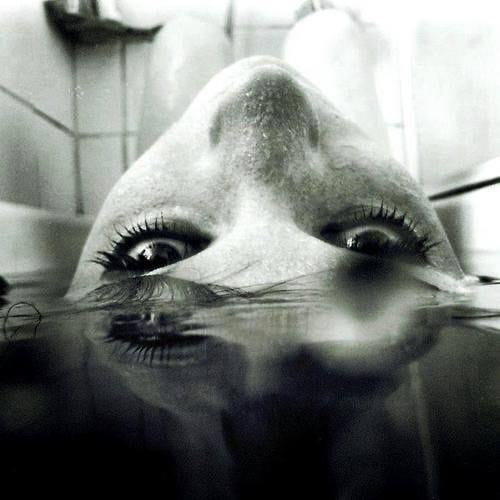
Gratitude is about what’s around you.
Self-worth is about whether you believe you deserve it.
Same with self-trust and self-love. I can love myself in the abstract, want good things for myself, talk kindly to myself, do the work and still not trust my own instincts. Still second-guess. Still hand the decision to someone else and feel relieved when they take it.
These things look similar from the outside but they feel completely different from the inside. I think I’ve been conflating them for a long time. And separating them out, even just naming them as different things, has felt unexpectedly useful.
Things I Loved on the Internet
I’ll be honest with you, I found this video the way I find most things: mindlessly scrolling, one autoplay away from an hour I didn’t plan to lose. The irony isn’t lost on me.

But this one stopped me. The speaker said something that landed quietly and then just... stayed. That there is another way to live: slow, with presence, with intention. Not mindlessly chasing the next thing to watch, the next thing to consume, the next hit of something. A different way entirely.
And I sat with that for a while. Because I find it genuinely hard not to overconsume. I open an app to check one thing and resurface forty minutes later, slightly emptier than before. I don’t think I’m alone in this. I think a lot of us have quietly accepted that this is just what it feels like to exist now.
But that line cracked something open. If there’s another way what does it actually look like? What does it feel like in the body to move through a day with that kind of intentionality? I don’t fully know yet. But now, every time I reach for my phone to open YouTube or scroll through something, I catch myself asking:
Is there another way I can spend this moment?
How can I protect my attention not just from the internet, but from the version of me that hands it away without thinking?
It’s a small question. But it’s changed the texture of my days in a way I wasn’t expecting.
Work that pulled me in
The Cyclops
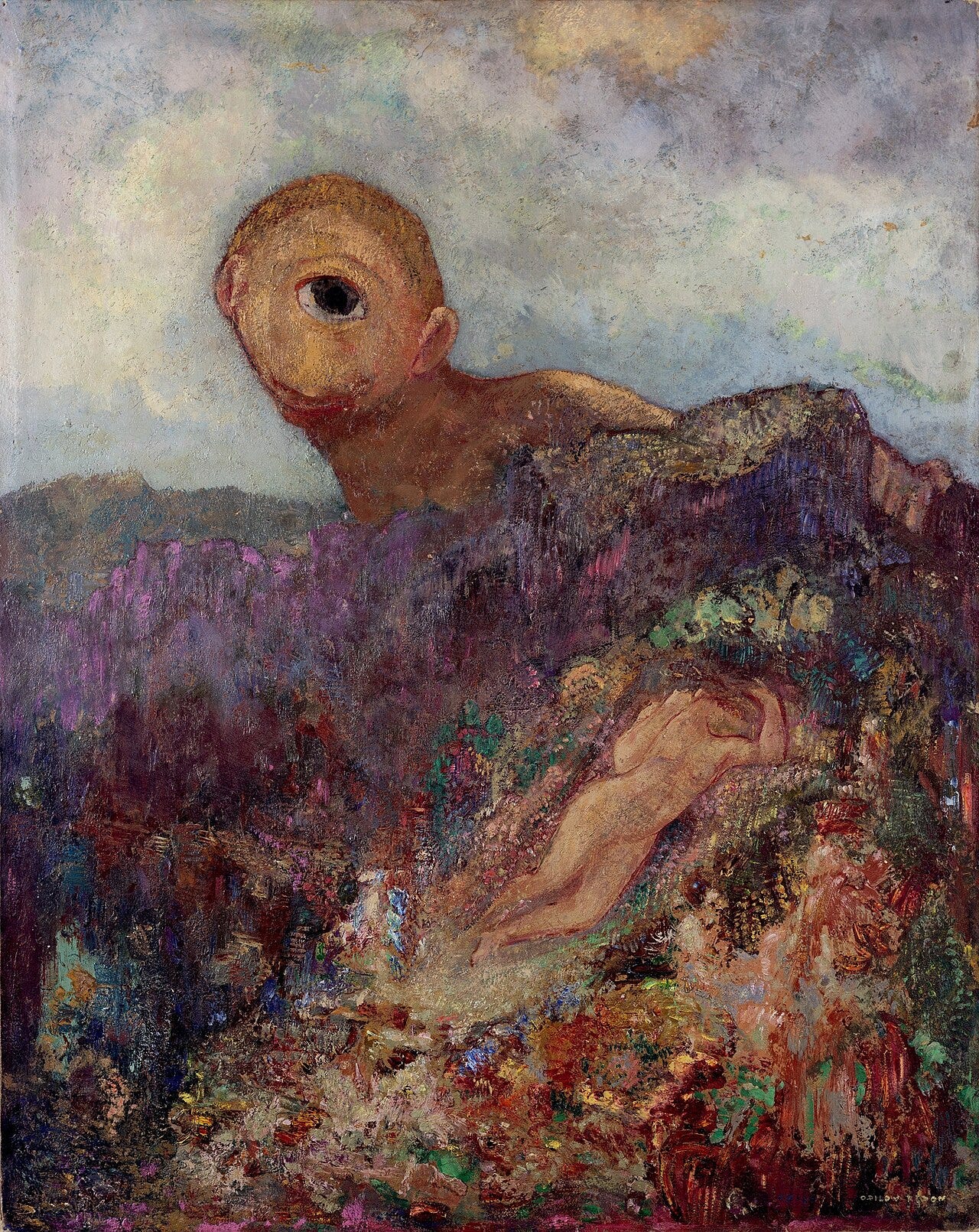
Odilon Redon · c. 1914 · Kröller-Müller Museum
A one-eyed giant peering over a mountain at a sleeping woman. The Cyclops Polyphemus, watching the Nereid Galatea, a love that will never be returned, painted in colours so vivid and strange they feel almost wrong for the weight of the scene. That’s what I noticed first: how beautiful it is. How unsettling it is that it’s beautiful.
But here’s the thing the story behind this scene is far darker than the painting lets on. Galatea isn’t exactly sleeping. She’s hiding. Polyphemus, the Cyclops, is obsessed with her in that particular way obsession works: he wrote her a love poem that starts as praise and slowly curdles into threat. He calls her beautiful.
Then he calls her an untamed heifer. Then he promises to tear her lover Acis limb from limb if she won’t choose him. Which he then actually does. He finds them together, hurls a boulder, and crushes Acis completely. Galatea jumps into the sea.
That’s the love story Redon chose to paint. Soft colours. Dreamlike blur. The most violent Greek myth wearing a pastel disguise.
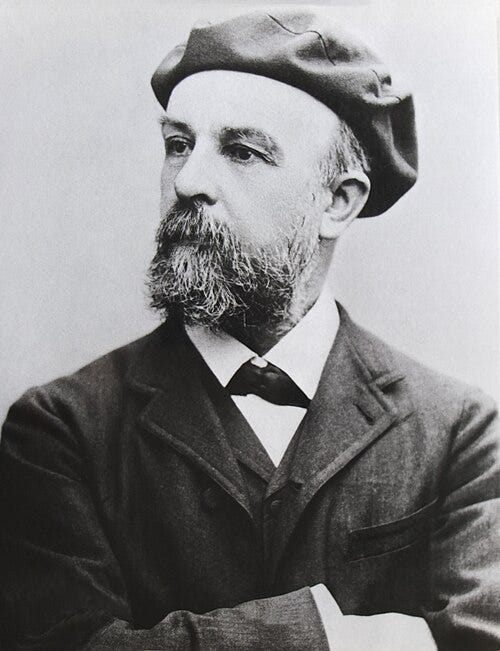
And that’s precisely the point. Notice how little structure the painting has the borders bleed into each other, the proportions make no logical sense, the mountain looks almost small behind the giant. Redon wasn’t being careless. He wanted the whole thing to feel like a dream you only half-remember: one or two things in sharp focus, the rest just haze. And the one thing you can’t look away from? That face. That eye. Because Redon spent years painting eyes.
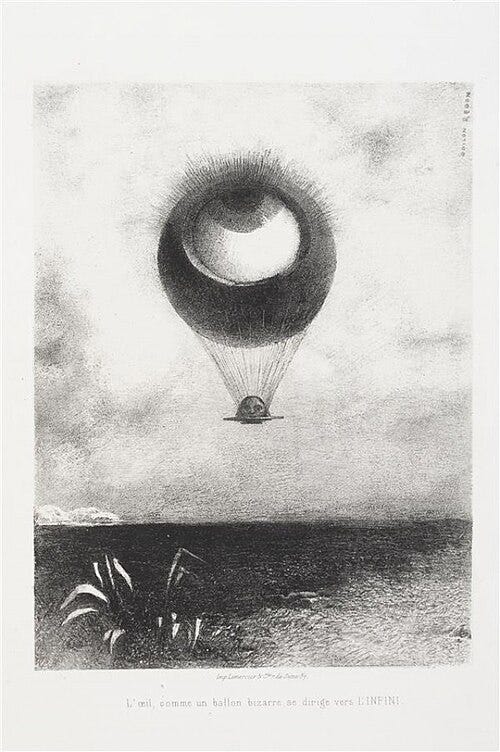
What stays with me is this: Polyphemus is not painted as evil. He looks almost innocent, a creature too simple to understand that love without consent is not love at all.
Redon wasn’t asking you to sympathise with him. But he wasn’t letting you look away either. Sometimes the most important seeing happens in the places that make you uncomfortable. Sometimes the eye watching from behind the mountain is also yours.
Everything in this month’s medley, I realised, was asking the same question in a different language: what deserves your attention and are you one of those things? I don’t have the answer yet. But I think asking it is somewhere to start.
Thanks for reading through my little collection. I hope something here sparked something in you too.
If this space helps you understand art a little better, feel less alone in your creative practice, or feel seen and validated in your inner creative landscape, you can support my work.
Your support helps me keep writing and creating for artists like you — slowly, honestly, and with care. Please subscribe and stay connected.
Every reader is part of what keeps this space alive.